During sudden cardiac arrest, chaotic electrical activity occurs in the heart, preventing it from pumping blood effectively. A defibrillator detects this abnormal electrical activity and delivers an electric shock to restart the heart and restore the normal sinus rhythm.
When sudden cardiac arrest happens, time is the most critical component.
An electric shock from a defibrillator is needed as quickly as possible.
Every minute of delay reduces the chances of survival by 10%. In the United States, 1000 people per day die from SCA, often because the paramedics just can’t get there fast enough.
The problem is traditional defibrillators are too big and bulky to be carried by heart patients. They are also too complex for many non-medically trained people to use.
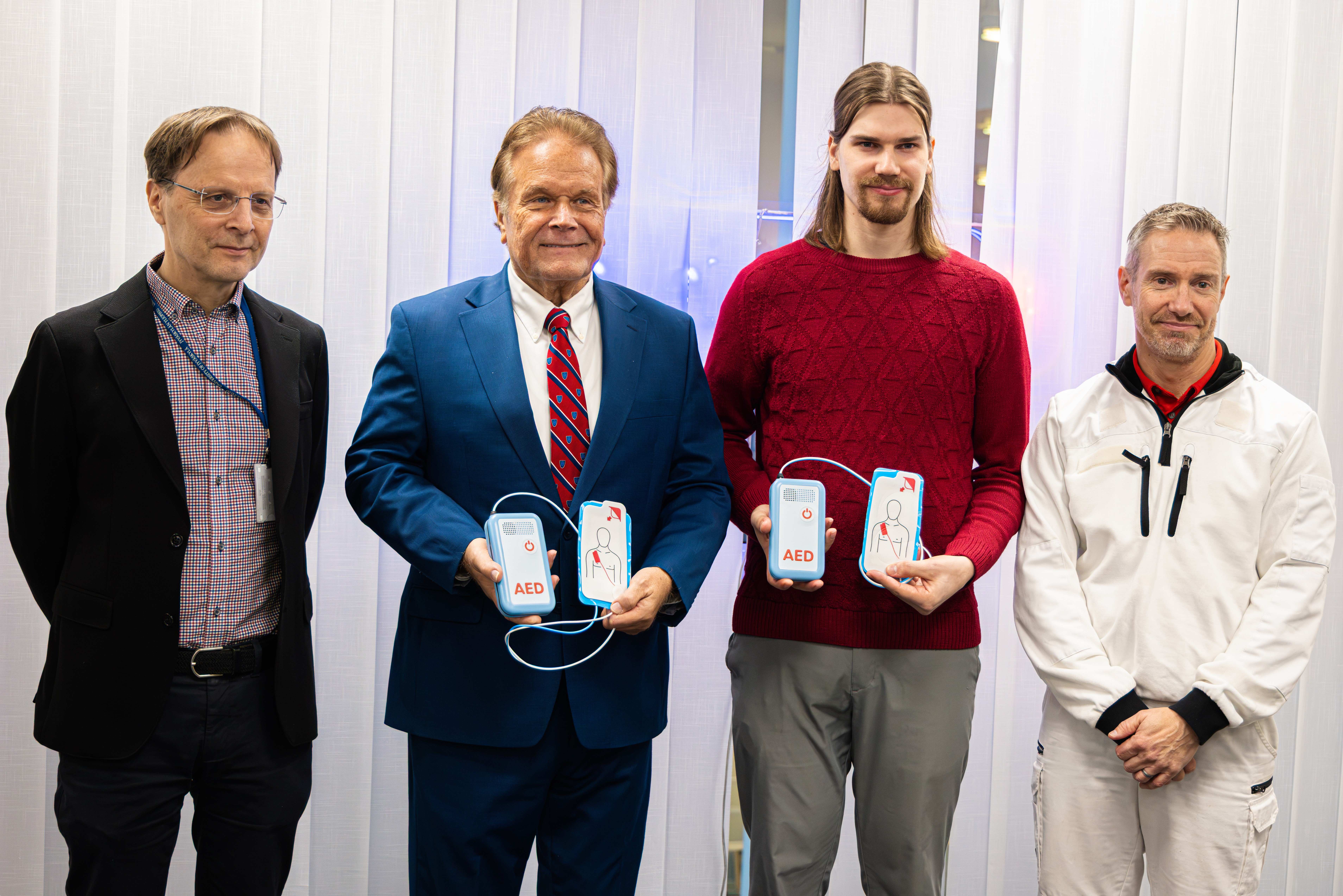
The CARDIASAVE solves both of these problems. Measuring roughly the size of a mobile phone, it has only one button and is very easy to use. Simple voice prompts guide the rescuer through the resuscitation process.
The CARDIASAVE is small enough to be carried by the spouse or family member of the heart patient wherever they go. Therapy can be administered without having to wait for the ambulance to arrive.
Kai Lahtinen, an experienced paramedic serving as Field Director for First Responders in Central Finland, is very excited about the new CARDIASAVE miniature defibrillator.
“i’ve used a defibrillator hundreds of times, and this new mini-version is exactly what is needed to save lives,” Lahtinen said.
“Our First Responders’ average response time is 6 to 8 minutes,” he continued. “We have statistical data indicating that the survival rate of cardiac arrest patients doubles whenever we get there in 3 minutes or less. Unfortunately, most of the time we can’t get there fast enough. We get caught in city traffic or get delayed due to weather,” Lahtinen noted regretfully..
“In rural areas the situation is even worse,” he explained. “Cardiac arrest survival rates are low because public defibrillators are scarce and ambulance response times are long.”
Lahtinen noted that the small size and ease of portability of the new mini-defibrillator are major breakthroughs. “It’s especially beneficial for heart attack survivors who remain physically active. They can take it with them wherever they go,” he said.
Lahtinen predicts that mini-defibrillators will become essential in the households of heart attack survivors and those with known risk factors for heart disease.
According to Tom Kuutti, CEO of USA Medical Electronix, the idea for a miniature defibrillator came to him from listening to his son, who was a Florida state certified paramedic working in an ambulance.
“My son frequently witnessed situations where the ambulance simply could not reach the cardiac arrest victim in time, resulting in tragic and potentially preventable deaths,” Kuutti said. To solve this problem, Kuutti, an aerospace engineer, envisioned using the latest electronic miniaturization technology to develop a pocket-sized defibrillator.
Kuutti put together a team of engineers to design, the electronic and mechanical hardware, and partnered with the University of Jyväskylä to develop the precise ECG analysis algorithm and related software.
“The ECG analysis software created at the University of Jyväskylä is truly cutting edge,” Kuutti noted. “It evaluates the patient's heart rhythm in real time to rapidly determine whether a shock is necessary.”
At the University of Jyväskylä, Information Technology Professor Dr. Lauri Kettunen said, “Designing the diagnostic software presented both a major responsibility and a valuable opportunity.”
Dr. Kettunen emphasized that because the technology directly impacts human health and survival, accuracy and reliability goals were paramount throughout development. At the same time, Kettunen noted that collaboration with an American high-tech company provided the university with crucial experience in commercializing scientific research and turning academic knowledge into a tangible medical product.
The project also served as a pivotal learning experience for research assistant Teemu Paloniemi, who worked as the software developer responsible for writing the program's core code. Paloniemi highlighted the unique value of participating in goal-oriented, real-world software engineering that goes beyond standard university coursework. He noted that the biggest takeaway from the defibrillator project was mastering the discipline of high-quality, rigorous, and precise programming required for life-critical medical devices.
The collaboration with the University of Jyväskylä was so successful that USA Medical decided to establish a wholly-owned subsidiary right in Jyväskylä, to serve as the center of R&D, distribution, and service for all of Europe.
FDA certification testing of the new device is scheduled to begin in the United States in early 2027. It could be available to consumers in the United States in 2028
This will be followed by the EU MDR certification process, which means the CARDIASAVE could be available to consumers in Europe in 2029.
At the SLUSH event, CEO Tom Kuutti hopes to connect with potential investors. The company is looking to raise capital to fund the FDA certification, purchase components, commence manufacturing, begin advertising, and launch the product.
SAKRI VIKLUND